This is the place to post your chiasmus based on Ralph Waldo Emerson's chiasmi.
In rhetoric, chiasmus (from the Greek: χιάζω, chiázō, "to shape like the letter Χ") is the figure of speech in which two or more clauses are related to each other through a reversal of structures in order to make a larger point; that is, the clauses display inverted parallelism. Chiasmus was particularly popular both in Greek and in Latin literature, where it was used to articulate balance or order within a text. As a popular example, the Greek and Hebrew texts of the Bible also contain many long and complex chiasmi.
Monday, April 25, 2011


Tuesday, March 29, 2011
Puritan Conceit
This is the place where you will post your Puritan conceits based on Edward Taylor's Housewifery.
Friday, March 18, 2011
Ironic Propaganda
This is the place where you will post your sarcastic add of Costa Rica based on Christopher Columbus' A Spectacle of Great Beauty and John Smith's A Description of the New Land.
Monday, November 8, 2010
Hamlet Garcia (Four Monologues) by Miguel Morillo
Mujer.- Sé cómo funcionan estas cosas, podría ser su madre y no me pilla de nuevas, sé cómo funcionan estas cosas porque he estado en decenas de entrevistas como esta. Son las nueve y cuarto de la mañana, me he levantado a las siete en punto, me he vestido con la mejor ropa que tengo, me he maquillado lo mejor que sé para la ocasión, porque siempre lo hago así, estoy sentada delante del jefe de personal y dos psicólogos que me observan y toman notas, que se fijan en mí, que escudriñan cada centímetro de mí.
He llegado aquí a las nueve menos cuarto, y me he metido en un bar para hacer tiempo, y desde las ocho menos cuarto hasta las nueve y diez me he bebido siete sol y sombras. Estoy borracha, estoy completamente pedo oyendo al jefe de personal, oyendo lo que dice, pero sin escucharle. No bebo, no he bebido nunca, no me gusta el alcohol, pero me he tomado siete sol y sombras en veinticinco minutos porque he pasado por esto decenas de veces y ya me da igual, he bebido de forma consciente, me he emborrachado adrede, me he puesto completamente pedo para evadirme de esto, porque sé lo que es esto, y sé que no va a ninguna parte.
Estoy sonriendo porque estoy totalmente trompa, el jefe de personal piensa que estoy sonriendo porque estoy dándole la razón, piensa que estoy sonriendo porque estoy de acuerdo con toda la sarta de gilipolleces que me está diciendo. El jefe de personal se equivoca. Los psicólogos me observan, toman notas, me miran y no dejan de apuntar cosas en un papel, y yo les miro escribir y les sonrío, y ellos me miran sonreír y anotan, porque piensan que el hecho de que yo sonría es lo mismo que darle la razón al jefe de personal, porque piensan que si sonrío es porque estoy de acuerdo. Los psicólogos se equivocan. Sonrío porque estoy totalmente evadida de la conversación, sonrío porque me he tomado siete sol y sombras en veinticinco minutos y estoy totalmente pedo.
Me lo estoy imaginando desnudo al jefe de personal, mientras habla, totalmente desnudo, es guapo, es un chico joven y guapo, habla muy rápido, habla con energía y convicción. Me estoy imaginando al jefe de personal desnudo, moviendo la lengua con energía y convicción, haciéndome un buen cunilingus, haciéndome feliz. Yo he sido sincero con usted, le he explicado lo que espero de usted sin rodeos, sin tapujos. Ir siempre con la verdad por delante es indispensable, no sólo en esta empresa, sino también en la vida.
Se queda mirándome, ha terminado, espera que hable, que le conteste, espera que haga el paripé y santas pascuas, le voy a decir la verdad, le voy a decir que todo esto me da absolutamente igual y que lo que realmente me apetece es que me tire sobre la mesa y me coma el coño bien comido. Se lo voy a decir, claro que se lo voy a decir, porque me he tomado siete sol y sombras en el bar de abajo y esto me da absolutamente igual. Abro la boca convencida de lo que voy a decir, dispuesta a decirle que me haga feliz, pero no salen palabras. Abro la boca y no salen las palabras, sale un chorro de vómito, salen los siete sol y sombras y un café con magdalenas que tomé en casa. Los pongo perdidos, los lleno de vómito, lleno de vómito al jefe de personal, a los psicólogos, lleno de vómito los apuntes de los psicólogos, la mesa del jefe de personal, las paredes del despacho, el suelo, mi vestido, lo lleno todo de vómito. De acuerdo, digo, soy la persona que buscan.
http://cal-reservorio.blogspot.com/2007/08/hamlet-garca-miguel-morillo.html
He llegado aquí a las nueve menos cuarto, y me he metido en un bar para hacer tiempo, y desde las ocho menos cuarto hasta las nueve y diez me he bebido siete sol y sombras. Estoy borracha, estoy completamente pedo oyendo al jefe de personal, oyendo lo que dice, pero sin escucharle. No bebo, no he bebido nunca, no me gusta el alcohol, pero me he tomado siete sol y sombras en veinticinco minutos porque he pasado por esto decenas de veces y ya me da igual, he bebido de forma consciente, me he emborrachado adrede, me he puesto completamente pedo para evadirme de esto, porque sé lo que es esto, y sé que no va a ninguna parte.
Estoy sonriendo porque estoy totalmente trompa, el jefe de personal piensa que estoy sonriendo porque estoy dándole la razón, piensa que estoy sonriendo porque estoy de acuerdo con toda la sarta de gilipolleces que me está diciendo. El jefe de personal se equivoca. Los psicólogos me observan, toman notas, me miran y no dejan de apuntar cosas en un papel, y yo les miro escribir y les sonrío, y ellos me miran sonreír y anotan, porque piensan que el hecho de que yo sonría es lo mismo que darle la razón al jefe de personal, porque piensan que si sonrío es porque estoy de acuerdo. Los psicólogos se equivocan. Sonrío porque estoy totalmente evadida de la conversación, sonrío porque me he tomado siete sol y sombras en veinticinco minutos y estoy totalmente pedo.
Me lo estoy imaginando desnudo al jefe de personal, mientras habla, totalmente desnudo, es guapo, es un chico joven y guapo, habla muy rápido, habla con energía y convicción. Me estoy imaginando al jefe de personal desnudo, moviendo la lengua con energía y convicción, haciéndome un buen cunilingus, haciéndome feliz. Yo he sido sincero con usted, le he explicado lo que espero de usted sin rodeos, sin tapujos. Ir siempre con la verdad por delante es indispensable, no sólo en esta empresa, sino también en la vida.
Se queda mirándome, ha terminado, espera que hable, que le conteste, espera que haga el paripé y santas pascuas, le voy a decir la verdad, le voy a decir que todo esto me da absolutamente igual y que lo que realmente me apetece es que me tire sobre la mesa y me coma el coño bien comido. Se lo voy a decir, claro que se lo voy a decir, porque me he tomado siete sol y sombras en el bar de abajo y esto me da absolutamente igual. Abro la boca convencida de lo que voy a decir, dispuesta a decirle que me haga feliz, pero no salen palabras. Abro la boca y no salen las palabras, sale un chorro de vómito, salen los siete sol y sombras y un café con magdalenas que tomé en casa. Los pongo perdidos, los lleno de vómito, lleno de vómito al jefe de personal, a los psicólogos, lleno de vómito los apuntes de los psicólogos, la mesa del jefe de personal, las paredes del despacho, el suelo, mi vestido, lo lleno todo de vómito. De acuerdo, digo, soy la persona que buscan.
Mujer madura.- Estoy sentada en un teatro, en la oscuridad de un teatro, viendo una de esas obras de ante y ensayo. Hay dos actores desnudos en mitad del escenario, y se están comiendo un pollo crudo mientras recitan pasajes de la Biblia con la boca llena de pollo crudo y yo les miro y pienso en lo que me gustaría fumarme un cigarrillo ahora mismo. Pero no se puede fumar en el teatro, se puede recitar la Biblia desnudo con la boca llena de pollo crudo, pero no se puede fumar. Tengo muchas ganas de fumar, quiero fumar, necesito fumar. Necesito un cigarro, porque hoy ha sido un día duro, porque hoy ha sido uno de esos días en los que no te pones de acuerdo con el mundo ni con la vida. Hoy ha sido uno de esos días en que todo va como el culo. Ha venido el del butano. A las ocho de la mañana, a dejarme la bombona de butano que le encargué ayer, pero se me olvidó sacar dinero ayer por la noche. No tengo dinero. No podía pagar el butano, no podía abrirle la puerta. Y el tipo se ha mosqueado y ha estado llamando al portero un cuarto de hora seguido, sin parar, y los perros de la vecina de al lado se han puesto a ladrar, y la vecina de abajo ha abierto la ventana y se ha puesto ha insultarme. A las ocho de la mañana.
He hecho café y me he vestido para ir al trabajo, y me he equivocado al ponerme el azúcar, no he mirado los frascos y he puesto sal en el café, y lo he echado todo. Sobre el traje de chaqueta que llevo siempre al trabajo. He tenido que cambiarme y he llegado tarde al trabajo.
Mi jefe estaba fuera de sí porque esta mañana alguien le ha vomitado encima mientras hacía una entrevista. Y lo ha pagado conmigo. Y me ha gritado todo lo que ha querido y más. Y me ha cargado de trabajo y he tenido que quedarme hasta tarde en la oficina, así que para conseguir llegar a casa y que me diese tiempo a comer algo, he cogido el coche y atajo por la calle Segovia, pero a algún gilipollas se le ha ocurrido saltar desde el viaducto en plena hora punta, y se ha estampado contra el número 65 de la empresa madrileña de transportes, que casualmente iba delante de mí, y se ha montado la de Dios, y he tenido que esperar una hora en el atasco y me he quedado sin comer, y he llegado tarde al trabajo otra vez, y mi jefe ha vuelto a pagarlo conmigo y me ha vuelto a cargar de trabajo y he salido otra vez tarde, y de vuelta a casa me he encontrado con otro atasco en la carretera, y después de media hora parados en el atasco un tipo con cara de tonto que habían en mitad de la autopista me ha hecho parar el coche y casi lo atropello, y el muy… me ha sacado del coche de un tirón, me ha cogido y me ha sacado del coche de un tirón, me ha cogido y me ha sacado por la ventanilla. Y me he quedado en mitad de la carretera como una boba. Luego la policía me ha tenido dos horas haciendo la declaración de los hechos porque el tipo que me había cogido el coche lo había destrozado contra otro un poco más adelante. He decidio9 olvidarme, evadirme de todo, así que he cogido un periódico y he puesto el dedo al azar en la cartelera y ha salido esta obra de teatro, y me he venido a verla. Por eso estoy aquí, en este teatro, pero no consigo evadirme, porque hay dos tíos en bolas comiéndose crudo el pollo, mientras recitan la Biblia, y eso no me hace evadirme.
Tengo que fumar. Tengo que salir a fumar, así que me levanto y salgo, cruzo el patio de butacas con dirección a la puerta, y uno de los actores me tira lo que queda del pollo crudo a la cabeza. Viene hacia mí y me señala con el dedo y me dice que soy una escoria social, que me voy del teatro porque el mensaje que ellos transmiten es la verdad, y que la verdad me duele porque soy una alienada. Mira al público, me señala y les dice que soy un borrego alienado, y todos me miran y se ríen.
Tengo la seguridad de que hoy es un día duro, uno de esos días en los que te apetece no haberte levantado. Uno de esos días… uno de esos días en que no te pones de acuerdo ni con la vida ni con el mundo.
Me quedo mirando al tío, desnudo delante de mí, hablándome con la boca todavía llena de pollo, soltándome al hablar pequeños trozos de pollo crudo.
Por un momento no sé si reír o llorar. Por un momento todo lo que soy, todo en lo que creo está a punto de venirse abajo.
Miro al tipo.
Recapacito, pienso.
Tomo aire y respiro, lentamente, con total serenidad.
Vuelvo a mirar al tipo y vuelvo a tomar aire.
Tranquila, me digo, tranquila.
Soy una mujer fuerte.
Soy una mujer fuerte.
Soy una mujer fuerte.
Soy una mujer fuerte.
Soy una mujer fuerte.
Me repito interiormente.
Voy a mirar a los problemas cara a cara, voy a coger al toro por los cuernos. Voy a ponerme de pie después de la caída. Voy a mirar al frente y voy a seguir adelante. Con ánimo, con alegría, con entusiasmo.
Miro al actor, desnudo delante de mí, y le pego una patada en los huevos con todas mis fuerzas.
Descargo toda mi rabia, toda la rabia que he acumulado a lo largo del día.
Toda mi rabia contenida, dirigida hacia la punta de mi zapato y descargada sobre sus testículos indefensos.
Se cae al suelo y el dolor es tan profundo que ni siquiera puede quejarse, ni siquiera puede gritar.
Me doy la vuelta y miro al patio de butacas. Y vosotros podéis iros todos a tomar por el culo, grito, y salgo de la sala dando un portazo.
Dentro de la sala la gente empieza a aplaudir, se están dejando las manos, están aplaudiendo muy fuerte. Escucho los aplausos y pienso que les acabo de mandar a tomar por el culo…
Hoy es uno de esos días, Uno de esos días en que no te poner de acuerdo con la vida ni con el mundo. Uno de esos días en los que piensas que sería mejor no haberse levantado de la cama.
Hombre adulto.- Levantarse por la mañana y oler el café recién hecho, notar el agua caliente en la piel y luego el contacto con la cuchilla de afeitar, mirarse al espejo, el sabor del zumo de naranja, las tostadas, el primer cigarrillo de la mañana, abrir la ventana y notar el aire fresco, el sol, el calor del sol. Observar las cosas sencillas detenidamente, disfrutar de las cosas sencillas detenidamente. Hacerlo todo como si fuese la primera vez. Salir a la calle, mirar a un lado y al otro y notar que todo tiene sentido, que la cosa funciona. Sentirse afortunado.
Yo me siento afortunado porque he mirado detenidamente las cosas sencillas, he pensado, he discernido, he decidido sobre ellas y las he comprendido. Me he observado detenidamente a mí mismo mientras observaba detenidamente las cosas sencillas y me he dado cuenta de lo afortunado que soy pudiendo observar la sencillez de las cosas.
Observar las cosas, pensar sobre las cosas, decidir sobre las cosas, hacer o dejar de hacer las cosas. Sentirse vivo, tener conciencia de la propia existencia. Disfrutar de la existencia, disfrutar de la vida.
Me he quedado mirando una naranja, la hermosura, la compleja sencillez de una naranja, la he observado durante bastante tiempo. Una naranja nunca podrá disfrutar de la vida, una naranja está viva, pero nunca podrá disfrutar de la vida. Para poder disfrutar de la vida hay que tener conciencia de la propia existencia, tener la capacidad de observar las cosas. Una naranja está viva, pero una naranja no es consciente de su propia existencia, no puede disfrutar de su existencia, no puede disfrutar de la vida.
Yo soy consciente de mi existencia, por tanto puedo disfrutar de la vida, por eso me siento afortunado, por eso observo las cosas sencillas y me siento afortunado. Por eso me siento feliz.
Hombre joven.- Pasar desapercibido. Ser uno más, No destacar. No llamar la atención. Ser uno más. Ser el vecino que no saluda a nadie y al que nadie saluda. Ser el vecino en el que nadie se fija. Ser cualquiera de los que van en un autobús cualquiera a cualquier sitio. Pasar desapercibido. Ser uno más. No llamar la atención. Que nadie te señale con el dedo, que nadie te llame la atención, que nadie te pare por la calle y te pregunte si tienes un minuto o un cigarrillo, que nadie te pregunte la hora. Que nadie te llame por tu nombre, que nadie conozca tu nombre. Ser uno más, uno cualquiera, en una calle cualquiera, yendo hacia cualquier sitio.
Que te dejen tranquilo, que no te molesten. Ser uno más sin pena ni gloria, uno más. Que no suene el teléfono, que no te llame nadie, que nadie tenga tu número. Que te dejen tranquilo. Ser cero. Ser menos que cero. Ser un cero a la izquierda. Que nadie te eche de menos. Que nadie te llame un sábado por la noche para salir a cualquier sitio. Ser uno más de los que están aquí. Sentarse en la oscuridad de un teatro y que nadie se fije en tu cara al entrar o al salir. Ser uno más, pasar desapercibido.
Ser un número más en las estadísticas, como cualquiera. Un número más. Sin cara, sin nombre, un número más. Que el de la tienda de al lado no sepa quien eres ni lo que sueles comprar. Que las únicas cartas que aparezcan en el buzón sean recibos enviados por un ordenador. Que no aparezca tu nombre en el buzón. Ser un número, sólo un número, ser un número más. Ser cero, ser menos que cero. Pasar desapercibido. No llamar la atención, que nadie te llame la atención. Ser uno más. Ver la televisión sin que los demás te vean a ti, sin que los demás se fijen en ti, sin que nadie te moleste.
No depender de nadie, que nadie dependa de ti, estar en casa, tranquilo, viendo la televisión, sin molestar a nadie y sin que nadie te moleste a ti. Ser uno más. Pasar desapercibido, no llamar la atención. Ver la pantalla, las caras que aparecen en la pantalla sin que ellas te vean a ti.
http://cal-reservorio.blogspot.com/2007/08/hamlet-garca-miguel-morillo.html
Saturday, August 7, 2010
Norming the Female Body: Discourses of Sexuality in Charles Swinburne (Third Part) by Lai Sai Acon Chan
Kristevan semiotics, asserts Toril Moi, “emphasizes the marginal and the heterogenous as that which can subvert the central structures of traditional linguistics” (161). In this sense, Swinburne’s poetry can be said to manifest marginal types of discourse, especially in “Dolores” and in “Anactoria.” His portrayal of a sadomasochistic unchaste virgin and of a lesbian with destructive-creative impulses typify Julia Kristeva’s process of signification and Hélène Cixous’ writing the body, both processes that aim at deconstructing the linear, goal-oriented language of patriarchy . Dolores is the embodiment of goddess and demoness. As a virgin, she is certainly an unorthodox one. Rather than a more joyful or pious type of virgin, the mystic and somber Dolores is Our Lady of Pain, a cruel patroness. Her physical description is utterly disturbing and points at the destruction and pain she is capable of inflicting: cold eyelids, heavy white limbs, hard eyes, cruel red mouth, lips full of lust and laughter, fangs, ravenous teeth. However, the effect she has on an acolyte is actually soothing as he urges her to “press with new lips where [she] pressed. For [his] heart too springs up at the pressure” (28-29), so that he could be filled with pleasure. By calling her Notre-Dame des Sept Douleurs, Swinburne mocks the authority of the Christian faith and shakes one of the pillars of patriarchal Western thought, the church. Dark, pagan, overtly-sexualized goddesses like Dolores, Astarte, and Venus, not God, become the object of worship of fervent followers of a semiotic cult verbalized in what in Kristevan terms is “the discourse of the illogic, the unconscious, the impulsive, the repressed, the transverbal, the atemporal” [my translation] (Macaya 87). This discourse that usually manifests itself in the gaps and inconsistencies of the linear, rational language of patriarchy, surfaces in “Dolores” and in “Anactoria” as a language of the female body, that is, as what Cixousian critics have termed “écriture feminine”[1].
To Cixous, writing that is said to be feminine comes from the eroticization of the body. “Almost everything is yet to be written by women about femininity: about their sexuality, that is, its infinite and mobile complexity, about their eroticization, sudden turn-ons of a certain miniscule-immense area of their bodies [. . .]. A woman’s body with its thousand and one thresholds of ardor [. . .] will make the old single-grooved mother tongue reverberate with more than one language” (885) . In this sense, Dolores’ is a sexuality that celebrates transgression while it functions as a type of bodily, erotic discourse. Constant references to her body’s transformative powers render it a site of “jouissance.” One can imagine her “lips full of lust and of laughter” (25) curb in a sardonic smile as she blows, bends, and breaks the bodies of those willing to follow her to her “house of unquenchable fire” (23) and writhe but in ecstatic pangs: “Ah, feed me and fill me with pleasure,/ Ere pain come in turn” (31-32). Like female sexuality, writing said to be feminine is “a multiple and inexhaustible course with millions of encounters and transformations of the same into the other and into the in-between, from which woman takes her forms” (Cixous 883), that is multiple instead of single, diffuse instead of focused, oriented toward process instead of goal-oriented. Indeed, the structure of the poem is more diffuse and process-oriented, and the signs are multivalent. Unlike more readable types of poems such as ballads and narrative poetry, Swinburne’s “Dolores” does not tell a story with a discernible beginning and a clear-cut end. On the contrary, the poem concentrates on extricating the different possible meanings of Dolores’ body: “splendid and sterile” (71), “bitter and tender” (87), “sanguine and subtle” (103), “fierce and luxurious” (135), “my sister, my spouse, and my mother” (151), “sleepless and deadly” (215), “a goddess new-born” (336), “a mortal, a maiden/ A queen over death and the dead” (347-48), “Most fruitful and virginal, holy” (351). Instead of telling a linear, logical story about Dolores, those sets of contradictory meanings render her as a process of endless signification rather than as a Manichean type of ambiguity that is solved from the start. Finally, by stressing the multiple values of the female body, Swinburne writes and rewrites the body of Dolores giving it a different meaning each time anew. Thus, she has “cold eyelids” but they “hide like a jewel” (1). In the same way, hers are “Hard eyes,” yet they “grow soft for an hour” (2); hers is the “bosom [that] no fasts could emaciate,/ No hunger compel to complain/ Those lips that no bloodshed could satiate” (261). “The white wealth of [her] body [is] made whiter/ By the blushes of amorous blows” (267-68) because Dolores is “fed with eternal breath/ And alive after infinite changes” (58-59). Since this is a language that mimics the subversive laugh of an ultimately abnormal woman (in allusion to Cixous’ groundbreaking homonym article, “The Laugh of the Medusa”) it is intended to “wreck partitions, classes, and rhetorics, regulations and codes” (886).
“Anactoria” is Swinburne’s celebration of homoerotic love and still another attempt at developing marginal discourses springing from the female body. It is through a boundless, more often than not, violent ardor that Sappho’s and Anactoria’s bodies are able to go past the lily/rose constraint. As lesbians, neither one can fit into the conventional roles as mothers, wives or femme fatales that originate in biological circumstances. Thus, they stand in direct opposition to normalcy and, to a certain extent, represent what Cixous called the third body. The constant references to seemingly destructive actions like blinding, burning, dividing, severing, crushing, bruising, scourging, and consuming among many others in the lesbian sexual act, would point to an utterly destructive kind of love and a canceling out of each other; however, in accordance with Cixousian thought they actually “offer the gift of alterity, producing rather than reducing difference” (Bray 63). In “Anactoria,” Sappho starts by urging the object of her love to see what the effects of that love have caused:
My life is bitter with thy love: thine eyes Blind me, thy tresses burn me, thy sharp sighs
Divide my flesh and spirit with soft sound,
And my blood strengthens, and my veins abound.
I pray thee sigh not, speak not, draw not breath;
Let life burn down, and dream it is not death. (1-6)
A love like Anactoria’s is so irreverent in the patriarchal world that it has the power to erase all traces of convention, and rather than in the logical language of the Father, this love is expressed in the transverbal language of the Mother. The great love between the women is then expressed through pulsations coming from the body. But in the process a strong clash between the bodies of Sappho and Anactoria must necessarily occur: “”I feel thy blood against my blood: my pain/ Pains thee. And lips bruise lips, and vein stings vein” (11-12). And so does the third body emerge, as “that which is created through the exchange, the flow, of desire” (Bray 64), but also as an unlawful entity that exists in “Anactoria” only as the product of the consummation of two female bodies rather than as the more conventional union of a male body and a female body.
Like the dark and diseased pre-New Woman figure that Christina Rossetti sketched in some of her literary works, Swinburne’s primordial women and terrible women offer a third possibility for the nineteenth century women within the limits of the dominant sexual politics of the time. His marginal discourses, ambiguity, and never-ending signification are an expression of what Allison Pease calls the aesthetics of obscenity. Pease argues that the nineteenth century “inherited the oppositions between pornography and aesthetics that were created in the eighteenth century” (38). It is not until the sexual body is elevated to the status of art and included in the realm of legitimate culture that marginal, ambiguous, open-ended discourses like Swinburne’s are normed. In stylizing “panting bodies typically associated with pornography,” “sexually enumerated” bodies through “sexually suggestive quotes” (64-65) that, as Dante Gabriel Rossetti once worried, would “make a few not even particular hairs stand on end, to say nothing of other erections equally obvious” (qtd in Pease 38) , Swinburne blurs the line between low and high culture, the erotically perverse and the properly decent, the aesthetically obscene and the distastefully lewd. In the process, his poetry (just like C.G. Rossetti’s literary production) “represents what Raymond Williams calls residual and emergent culture, either of which stands outside of the dominant culture and must in some way be incorporated lest they continue to pose a threat” (Pease 64). Once again, abnormal discourses on sexuality get caught in an endless game of normalizing the unstable, the aberrant, the eccentric. The marginal illusively moves to the center, but is actually incorporated and blended into a “new” center and, thus, an essentializing hegemonic discourse on sexuality belies it.
[1] Cixous has always refused to refer to feminine writing or masculine writing. She prefers to make a distinction between writing said to be feminine or writing said to be masculine. Interview with Verena Andermatt Conley in Hélène Cixous: Writing the Feminine.
Monday, May 17, 2010
Norming the Female Body: Discourses of Sexuality in Dante Gabriel Rossetti (First Part) by Lai Sai Acon Chan

The lily is the ideal type of woman who submits to every patriarchal whim and never replies impertinently or belligerently. In this respect, Gilbert and Gubar point out that, “There is a long and crowded road from The Booke of Curtesye (1477) to the columns of ‘Dear Abby,’ but social historians have fully explored [the conduct book’s] part in the creation of those ‘eternal feminine’ virtues of modesty, gracefulness, purity, delicacy, civility, compliancy, reticence, chastity, affability, politeness [. . .] (23). Rossetti certainly has a penchant for representations of demure women. Thus, one of the techniques he employs in his poems is that of imposing the male speaker’s thoughts and feelings on the women’s, that is, imposing phallocentric language on the women. In “The Blessed Damozel,” the lover is described as an omniscient being, while the damozel has a limited apprehension of her world. While he seems to know her every thought and movement, what she wears and what she says, she spends her time in heaven longing for her beloved and wondering when he will be able to join her. Like the proverbial angel in the house (Coventry Patmore’s “Angel in the House”), she is restricted to the domestic sphere—heaven—and patiently awaits his arrival as a dutiful wife would wait for her husband’s. In the meantime, she smiles, looks sweet and innocent with her lilies in her hand, the stars in her hair, and makes endless plans for their life together in paradise. This, however, is the lover’s version since the damozel is represented in the poem as he pictures her in heaven.
In Dante Gabriel Rossetti’s artistic works, the rose is, on the other hand, the type of woman who refuses those traditionally submissive roles but still pleases men with her deviant sexuality, a perverse sexuality that can only pertain to the fallen woman. The overt sexuality of women like Jenny, the woman in “The Orchard Pit,” and Lilith is not abhorred, but rather desired by men. Although a fallen woman, Jenny is akin to the angel in the house. She embodies the perfect mix of lily and rose, which is even more attractive than the devout angel in the house. With her “wealth of loosened hair,” “silk ungirdled and unlac’d” and “warm sweets open to the waist,” Jenny represents an all-but-innocent and virginal woman; but rather than adopting an overly forward attitude that one would expect from a harlot, she submissively puts her head on the male speaker’s knees. To further romanticize the fallen woman figure, like the sexual politics of his time dictated, Rossetti devotes a whole stanza to soften, even condone, Jenny’s profession. She is then compared to “a rose shut in a book / In which pure women may not look” (253-254), and to a “rose / Puddled with shameful knowledge” whose blood “flows / Through leaves no chaste hand may unclose” (264-66). Both images evoke an inner beauty that cannot be tarnished by such a shameful practice since the rose “still keeps such faded show / Of when t’was gathered long ago, / That the crushed petals’ lovely grain, / The sweetness of the sanguine stain” (267-270).
Norming the Female Body: Discourses of Sexuality in Christina Rossetti (Second Part) by Lai Sai Acon Chan
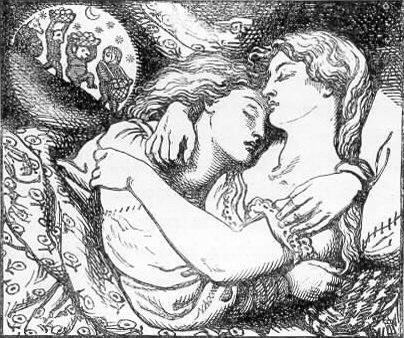
Christina Rossetti’s representations of the mid-Victorian female body challenge the normative notions about sexuality embodied by her brother’s angels and monsters. She transforms the dominant definition of the Victorian fallen woman in her depictions of a woman who, dis-eased with her biological circumstances, provides the seed for the 1890s New Woman, someone akin to the madwoman who thinks for herself, has a career and a story to tell, seeks internal enlightenment, challenges accepted ideas, and creates artistic works (Moi 58). Actually, in The Madwoman in the Attic Gilbert and Gubar contend that the literature of the nineteenth century portrays female characters and reveals female authors who apparently develop illnesses on purpose to purge their guilt, denounce their anger, find an outlet for their desires, or express their self-worth. In Bloomian terms, women writers in particular suffer from a kind of anxiety of influence, which when transposed to the realm of female creativity causes women an anxiety of authorship, “an anxiety built from complex and often only barely conscious fears of that authority which seems to the female artist to be by definition inappropriate to her sex” (Gilbert 51). Many of these groundbreaking women becoming precursors in fields traditionally dominated by men, put such a strain on them that their bodies, circumscribed by the “regulatory ideal,” produced diseases such as claustrophobia, agoraphobia, amnesia, aphasia, madness, and eating disorders, to further constrain them and keep them in their proper place. However, in many cases, argue Gilbert and Gubar, the female bodies reappropriated those maladies and turned them into dis-eases, that is, ways to signal nonconformity to sexual norms of the time.
In her attempts to transcend pre-fixed, essentialist labels, Rossetti portrays the female body as agonizingly trying to reshape itself, particularly through supernatural means. Her use of the preternatural in works such as “Goblin Market,” some of her ghost poems, some of her death poems, and stories like “Maude,” “Nick,” “The Lost Titian,” and “Hero” put in evidence the female body’s desire to escape the patriarchal prison of the flesh. Maude is a heroine trying to escape the prison of her body, indulges herself in dreams of rematerialization and provides a model for the New Woman. Torn between socially acceptable roles such as marriage and seclusion in a convent, Maude cannot avoid feeling guilty of the chosen path. She is burdened by a gift to write poetry that is rarely bestowed on other young women of her generation: “people thought her clever, and that her little copies of verses were handed about and admired. Touching these same verses, it was the amazement of everyone what could make her poetry so broken-hearted as was mostly the case” (“Maude” 253). Overwhelmed by the constant attention to her verse, she envies the simplicity and happiness of her cousins and friends, destined to fulfill patriarchal expectations. She constantly looks pale, “languid and preoccupied to a painful degree” (253) as a typically ill woman from the nineteenth century—in particular a female creator—must have looked like. She seems to use her malady to project the anxieties of being trapped in a normative woman’s body. Unlike Laura and Lizzie, she is not destined to fulfill the role of her cousin Mary nor does she hear the call of God, like her acquaintance Magdalen. Neither embroidery nor prayer is in Maude’s mind, but writing. However, writing is not a source of pleasure and tranquility, but something that reminds her of her abnormalcy in the eyes of Victorian patriarchy: “You cannot mean for the present that you will indulge in vanity and display; that you will court admiration and applause; that you will take your fill of pleasure until sickness” [. . .] (267). And yet, unlike her successor, the literary New Woman, Maude does not flaunt convention, ruin her honor, upset her family, or refuse to repent for alleged sins. The accident that keeps Maude bedridden is a symbol of her wish to escape from her prison: “she had been overturned; and, though no limb was broken, had neither stirred nor spoken since” (270). She develops both agoraphobia and aphasia in her unconscious attempt to confront the realization that she was moving away from the normative. Since she cannot cope with the guilt of being both so talented a poet and a woman, she gradually withers away until she breaks free from the constraints of the regulatory ideal and free from labels, even from the future New Woman label. While Maude’s anxieties are not a supernatural way of transcending patriarchal labels, they might reveal why Christina Rossetti had a proclivity for poems about ghosts and death and tales of transmutation.
Poems like “Chilly Night,” “The Hour and the Ghost,” “The Ghost’s Petition,” “A Nightmare,” and “At Home” are the type of poems that deal with spirits that transcended their prisons of flesh, while poems like “Death Before Dead,” “After Death,” “Remember,” “Song,” and “Sleeping at Last” deal with human beings who are only too glad to leave their bodies behind. Perhaps because they are narrative poems, the ghost poems do not seem to offer clues about those spirits’ former lives that made them glad they were finally set free, but it might be said that Rossetti’s inclination to write about them seems to indicate that fleeting to the realm of ghosts is just one possibility to transcend the lily/rose dichotomy. Then, like the New Woman or the madwoman in the attic, these ghosts demonstrate that even those who slipped into oblivion have a story to tell, unsavory opinions, or are willing to defy conventions. Some of the ghosts come back from the afterlife to disturb those they once knew. Yet, others make themselves visible to mortal eyes because they are more disturbed than when they were among the living. “The Ghost’s Petition” is the story of Robin, a spirit who, ailed by his former wife’s pain, pleads her not to grieve for him anymore: “I could not rest if you would not moan / Hour after hour; I have no power to shut my ears where I lie alone” (46-48) laments the ghost. In “The Hour and the Ghost,” a spirit comes back from the afterlife to exact a woman’s promise on her wedding day, despite her reluctance and revulsion:
Come with me, fair and false,
To our home, come home,
It is my voice that calls:
Once thou wast not afraid
When I woo’d, and said,
‘Come our nest is newly made’—
Now cross the tossing foam. (11-17)
Unlike this outspoken ghost, the ghost of the speaker’s mother in “A Chilly Night” speaks without a voice and stares without seeing, a sad reminder that for the friendless speaker, “Living had failed and dead had failed/And [she/he] was indeed alone” (49-50). The ghost “At Home” returns to her/his old house only to discover her/his friends in lively gatherings: “’Tomorrow,’ said they, strong with hope,/And dwelt upon the pleasant way,/’Tomorrow,’ cried they one and all,/While no one spoke of yesterday” (17-20). That is, the former self of the ghost was forgotten and was “Like the remembrance of a guest/That tarried but a day” (31-2). Like the troubling, yet equally troubled New Woman, the deceased people’s new state in the ghost poems is sometimes welcomed. Other times the new state is despised or rejected (and by extension the New Woman), and even makes some spirits long for their previous existence.
Subscribe to:
Posts (Atom)


